Laundry rooms have a way of becoming the most overlooked workhorse in the house. They handle towels, muddy clothes, school uniforms, pet blankets, cleaning supplies, extra paper products, and the random things nobody knows where else to put. Yet when people think about countertops, the laundry room is rarely the first space that comes to mind.
That is exactly why it is worth paying attention to.
A laundry room countertop does not have to turn the room into a full remodel. Sometimes the right surface simply gives you a place to fold clothes, sort laundry, set baskets, organize stain removers, or make the room feel more finished. The best laundry room countertop ideas are not only about how the space looks in a photo. They are about how the room works on an ordinary Tuesday when there are towels in the washer, sheets in the dryer, and a basket waiting to be folded.
Best Laundry Room Countertop Ideas Start With Daily Use
The best laundry room countertop ideas start with how you actually use the room. For many homes, that means adding a folding counter above side-by-side machines, creating a durable surface near a utility sink, using a smaller remnant piece for a compact counter, or choosing a quartz, stone, porcelain, or similar surface that makes the room feel more intentional without overcomplicating the project.
You do not need to know the exact material yet. At this stage, it is enough to notice what is missing from the space. Do you need a place to fold? Do you want the machines to feel built in? Is there an awkward gap that always collects clutter? Does the room feel like an afterthought compared to the rest of the house? Those questions can lead you toward a countertop idea that feels useful, not excessive.
Start With the Chore You Do Most
Before choosing a material or looking at photos, think about the task that happens most often in the laundry room. For many people, it is folding. Clothes come out of the dryer, land on top of the machines, slide around, get stacked in piles, or move to a bed because there is not enough room to fold where the laundry actually happens.
A counter over the washer and dryer can solve that in a very practical way. It creates one flat surface where laundry can be folded, sorted, and stacked before it leaves the room. In homes with front-loading machines, this can also make the appliances feel less like two separate boxes and more like part of a planned space.
The important detail is depth. A counter that is too shallow may look good but still feel awkward when you are folding towels or larger clothing. A counter that is planned around the actual appliance depth, wall clearance, and cabinet layout will usually feel more natural to use.
Create a Folding Counter Over the Washer and Dryer
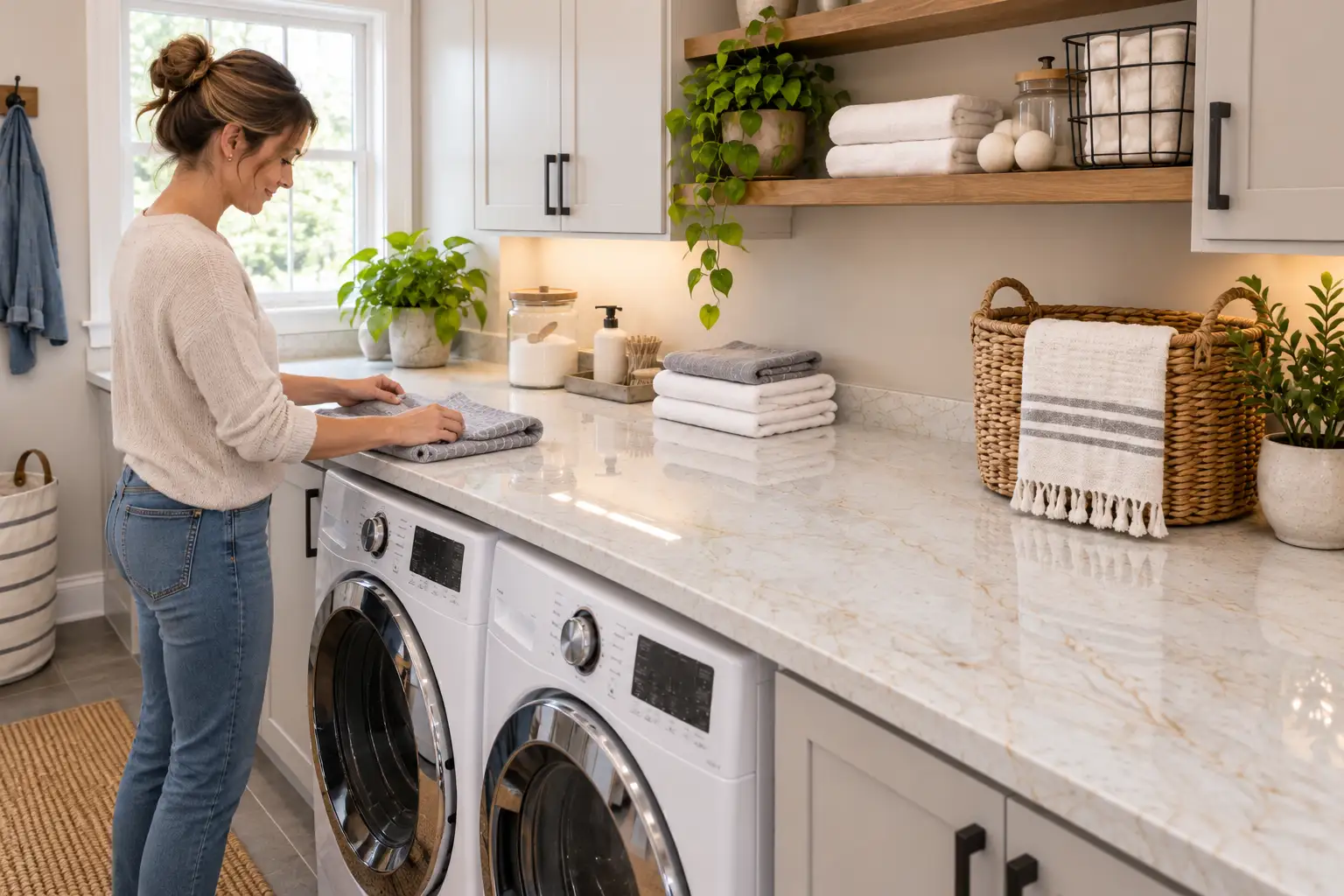
One of the most common laundry room counter ideas is a continuous surface over side-by-side front-load machines. This works especially well when the washer and dryer sit under upper cabinets, open shelves, or a hanging rod. The counter gives the room a visual stopping point and turns the top of the machines into useful working space.
If you like a cleaner look, the counter can stretch wall to wall so the appliances feel tucked into a built-in zone. If the room is smaller, even a shorter counter section can make a difference. The goal is not to make the laundry room look like a showroom. The goal is to make the routine easier every time you pull clothes out of the dryer.
This is also where surface choice matters in a practical way. Laundry rooms deal with detergent drips, damp towels, cleaning bottles, and the occasional wet garment. A surface that wipes clean and feels stable under daily use will usually be more satisfying than something chosen only because it looked nice in a saved photo.
Add a Counter Beside the Utility Sink
If your laundry room has a utility sink, a countertop around or beside it can make the space much easier to use. A sink area often becomes the place where people rinse stains, wash paintbrushes, fill buckets, soak small items, or clean up after pets. Without counter space nearby, everything ends up balanced on the sink edge, the washer, or the floor.
A counter beside the sink gives you a landing area. You can set down stain remover, brushes, folded towels, cleaning caddies, or items that need to air dry. Even a small section can change how the room feels because the sink stops functioning like an isolated fixture and starts becoming part of a real work zone.
This is a good place to think about splashes and upkeep. You do not have to dive deep into material comparisons yet, but it helps to choose a surface that fits the way the sink will be used. A decorative powder-room surface and a hardworking laundry sink counter may not need the same personality.
Use a Smaller Countertop to Make the Room Feel Finished
Not every laundry room needs a long counter. In some homes, the right idea is a smaller countertop over a cabinet base, between tall storage units, or along one short wall. This can give the room a finished feeling without taking over the floor plan.
Smaller counters are especially useful in laundry rooms that also work as mudrooms, pantry overflow, pet areas, or cleaning supply storage. A compact counter can hold keys, mail, dog leashes, folded hand towels, or baskets waiting to go upstairs. It may not be the biggest surface in the home, but it can become one of the most used.
This is also where homeowners sometimes get more creative. A smaller area may allow you to consider a more distinctive surface than you would choose for a full kitchen. A dramatic remnant, a quiet quartz, a porcelain piece, or a natural stone with movement can all work depending on the room, the cabinets, and how visible the laundry area is from the rest of the house.
Consider a Remnant for a Laundry Room Countertop
Laundry rooms can be a smart place to think about remnants because the countertop area is often smaller than a full kitchen. A remnant is a remaining piece of stone, quartz, porcelain, or another surface material that may be large enough for a smaller project such as a laundry room counter, vanity, bar, shelf, or utility area.
The benefit is not only budget. Remnants can also help you find something with character for a space that does not require multiple full slabs. If your laundry room needs one smaller counter, a remnant may open up options you would not have considered otherwise.
The key is to stay flexible. Remnants are based on what is available at the time, so this is not the best path if you need one exact color, one exact pattern, and one exact size. But if you are open to walking through the options and seeing what could work, a laundry room can be a great place to use a piece that already has the right size and feel.
Match the Countertop to the Rest of the House
A laundry room countertop does not need to match the kitchen exactly. In many homes, it actually works better when the laundry room has its own quieter, simpler direction. Still, it should feel like it belongs to the same house.
Look at nearby finishes before deciding what kind of counter feels right. Cabinet color, flooring, wall paint, door hardware, and lighting all affect how a surface will read in the room. A cool gray counter may look crisp with white cabinets and tile floors but feel flat next to warmer wood tones. A warmer stone or quartz may make a utility space feel softer and more connected to the rest of the home.
This is why samples matter. A cabinet door, flooring sample, paint swatch, or backsplash piece can tell you more than a saved inspiration photo. Photos help you notice what you like, but your own finishes help you decide what will actually work.
Think About the Edges and Corners
Laundry rooms are active spaces, so the little details matter. People carry baskets through narrow walkways. Kids open cabinet doors quickly. Cleaning supplies get pulled in and out. If the counter is near a doorway, appliance opening, or tight corner, edge shape and placement deserve attention.
A slightly softened edge can feel better in a room where people brush past the counter often. A counter that extends too far beyond the machines or cabinets may look generous on paper but feel annoying in daily use. A counter that is planned around baskets, doors, and traffic flow will usually feel more useful than one that simply fills the available wall.
This is one of those practical details that is easy to miss when you are only looking at pretty laundry room photos. A real laundry room has movement. The countertop should support that movement instead of getting in the way.
Do Not Forget Storage Above and Below
A countertop works best when it supports the storage around it. A folding counter below open shelving can create a nice rhythm: baskets above, work surface in the middle, machines or cabinets below. A counter over base cabinets can turn a blank wall into a place for extra detergent, cleaning cloths, pet supplies, or seasonal items.
For smaller rooms, vertical storage is especially important. The countertop gives you the work surface, but shelves, cabinets, hooks, and rods help keep that surface from becoming the new clutter zone. If the counter is always covered, it stops doing the job you added it for.
Think of the countertop as the working layer of the room. Everything around it should help keep that layer usable.
Choose a Surface That Fits Real Laundry Room Life
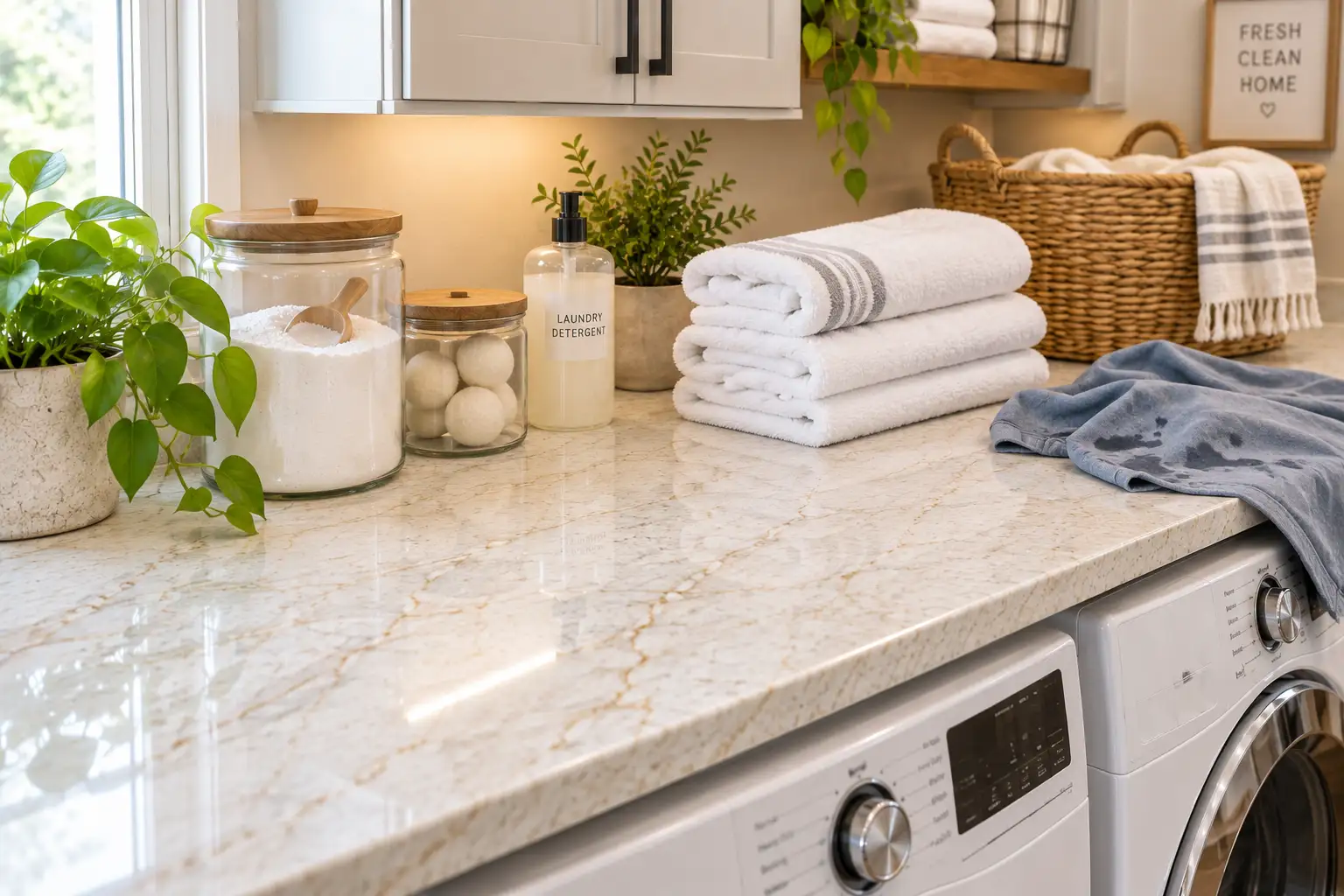
Laundry rooms are not as demanding as kitchens in some ways, but they have their own kind of wear. There may be moisture from damp clothes, detergent spills, bleach products, cleaning sprays, baskets dragged across the surface, or heavy bottles set down in the same spot every week.
That does not mean you need the most intense material possible. It means the surface should fit your habits. If the laundry room is mostly for folding clean clothes, your needs may be different from a room with a utility sink, pet-washing area, or heavy cleaning storage. If the laundry room is visible from the kitchen, hallway, or mudroom, appearance may matter more than it would in a closed-off utility room.
Quartz, natural stone, porcelain, Dekton, and remnants can all make sense in the right situation. The best choice depends on the size of the counter, how the room is used, what look you want, and how much maintenance you are comfortable with.
Let the Laundry Room Be Its Own Project
One reason laundry rooms stay unfinished for years is that people mentally attach them to a much bigger remodel. The thinking goes, “We’ll deal with that when we redo the kitchen,” or “It’s only the laundry room, so it can wait.” Sometimes that makes sense. But sometimes a smaller countertop project is exactly what helps a neglected space become easier to use.
You do not have to redesign the whole room to improve it. Adding a folding surface, replacing a builder-basic counter, using a remnant over a cabinet base, or making the washer and dryer area feel more built-in can be enough. The change is practical first, which is why it tends to feel worthwhile after the novelty wears off.
A laundry room countertop is not about making the room fancy. It is about making a space you already use work better.
Explore Laundry Room Countertop Ideas in Person
Start by taking a photo of your laundry room as it is right now. Look for the spot where things pile up, where folding feels awkward, or where a small counter could make the room easier to use. That one photo will usually tell you more than a dozen inspiration images.
When you are ready to explore what different surfaces could look like in person, visit RBG Surfaces in Garden City. Bring your photos, samples, and rough ideas. You do not need to know exactly what you want yet. Sometimes the first step is simply walking through the options and seeing what catches your eye.