You found the slab. The color works with the cabinets, the movement looks right across the island, and you can already picture it in the finished kitchen. There is only one problem: your cabinets may not be installed for several months.
Now you are caught between two reasonable concerns. You do not want someone else to buy the exact slab you chose, but you also do not want to place a deposit before you know whether your project needs one slab, two slabs, or additional material for a backsplash or waterfall edge.
How Early Should You Reserve a Countertop Slab?
It is not necessarily too early to reserve a countertop slab several months before installation. At RBG Surfaces, once you purchase your slab, we can hold it for up to one year while your cabinets, construction schedule, and other project details are completed.
Before purchasing, we offer a complimentary hold for up to seven business days. That gives you time to have a fabricator review the preliminary layout, confirm the likely number of slabs, and make sure the material will cover the complete project.
The key is not how many months remain before installation. The key is whether the project is developed enough to confirm the material and likely quantity. Once those details have been reviewed, purchasing early can protect the exact slab you chose without forcing you to rush the rest of the remodel.
Yes, RBG Can Hold Your Purchased Slab for Up to One Year
Finding the right slab early does not mean your cabinets need to be ready for templating next week.
At RBG Surfaces, we can hold purchased slabs for up to one year. This is especially helpful for new construction, phased remodels, delayed cabinet installations, and projects where the homeowner wants to build the remaining design choices around a specific piece of stone.
That longer storage window gives you room to:
- Wait for cabinets to arrive and be installed
- Complete flooring, electrical, or plumbing work
- Finalize appliances, sinks, and fixtures
- Coordinate the fabricator’s schedule
- Work through reasonable construction delays
- Use the actual slab to guide paint, backsplash, and hardware decisions
You do not have to leave a one-of-a-kind natural-stone slab available for someone else simply because installation is several months away. Once it has been purchased, RBG can keep it stored for your project for up to one year.
The important step is confirming the likely quantity before purchasing. Long-term storage protects the slabs you bought, but it cannot solve a shortage if the project later requires an additional matching slab that was not included in the original purchase.
A Complimentary Hold Is Different From Storage After Purchase
RBG offers a complimentary slab hold for up to seven business days before purchase. This temporary hold gives you time to verify the project details without immediately committing to the material.
Use that seven-business-day period to:
- Send the preliminary cabinet plan to a fabricator
- Confirm whether the project needs one slab or multiple slabs
- Include islands, backsplashes, and waterfall panels in the review
- Confirm that all required slabs work together visually
- Review the installed estimate and overall project budget
- Ask any questions about the purchase and storage terms
Once the slab is purchased, RBG can hold it for up to one year. This means the complimentary hold is the decision window, while the one-year storage period gives the construction project time to reach the templating and installation stages.
Why Purchasing Early Can Make Sense
Purchasing early can be a practical decision when you have found a distinctive natural-stone slab that would be difficult to replace. Natural stone varies from slab to slab, so returning several months later may not produce the same background color, movement, veining, or mineral details.
Early purchase can also help when:
- Your project needs two or more related slabs
- The stone will be the focal point of a large island
- You want the backsplash, cabinets, and paint selected around the slab
- Your remodel is active but cabinet installation is still months away
- Your new-build timeline may move as different trades complete their work
- You want to cross the stone selection off your project list without rushing installation
Because RBG can store purchased slabs for up to one year, homeowners do not have to choose between protecting the stone and forcing the project forward before it is ready.
Finding the Slab and Securing the Slab Are Two Different Steps
When you find a slab you want, the first step is usually a temporary hold. A temporary hold gives you time to speak with your contractor, fabricator, designer, or cabinet company before making a longer commitment.
At RBG Surfaces, we offer a complimentary slab hold for up to seven business days. After that period, a deposit is required to continue holding the material for your project.
Those seven business days should not be treated as extra browsing time. Use them to confirm the information that could affect whether the slab is actually right for the project:
- The number of slabs you are likely to need
- The size and general shape of the island
- Whether the backsplash will use the same material
- Whether you are planning waterfall panels
- Whether the sink, cooktop, or range location is changing
- Whether multiple slabs need to match
- Whether your project budget covers the full scope
A hold may temporarily protect the material, but it does not confirm that you have reserved enough of it. That is why the quantity review should happen before the complimentary hold expires whenever possible.
Do Not Reserve Based Only on Approximate Square Footage
One of the most common planning mistakes is assuming that countertop square footage tells you exactly how many slabs to purchase. Square footage is useful for an early estimate, but it does not account for how the individual countertop pieces must fit onto the slab.
A fabricator also has to consider the slab’s actual dimensions, usable stone area, veining direction, seam locations, cutouts, edge details, and any areas that should not be used. A kitchen that appears to fit within one slab by total square footage may still require two because the island, perimeter runs, or vein direction cannot be arranged efficiently on one piece.
This becomes even more important with high-movement natural stone. You may want the veins to travel in a particular direction across the island, continue through a backsplash, or align across a waterfall panel. Those design choices can change how much usable material the project requires.
Before placing a deposit, ask a fabricator to review the preliminary plan and answer a direct question:
“Based on this layout and this specific slab, how many slabs should I reserve?”
That review may not be the final template. It is an early quantity check intended to prevent you from securing one slab and discovering months later that the project needed two matching slabs.
Why Matching Slabs Should Be Confirmed Early
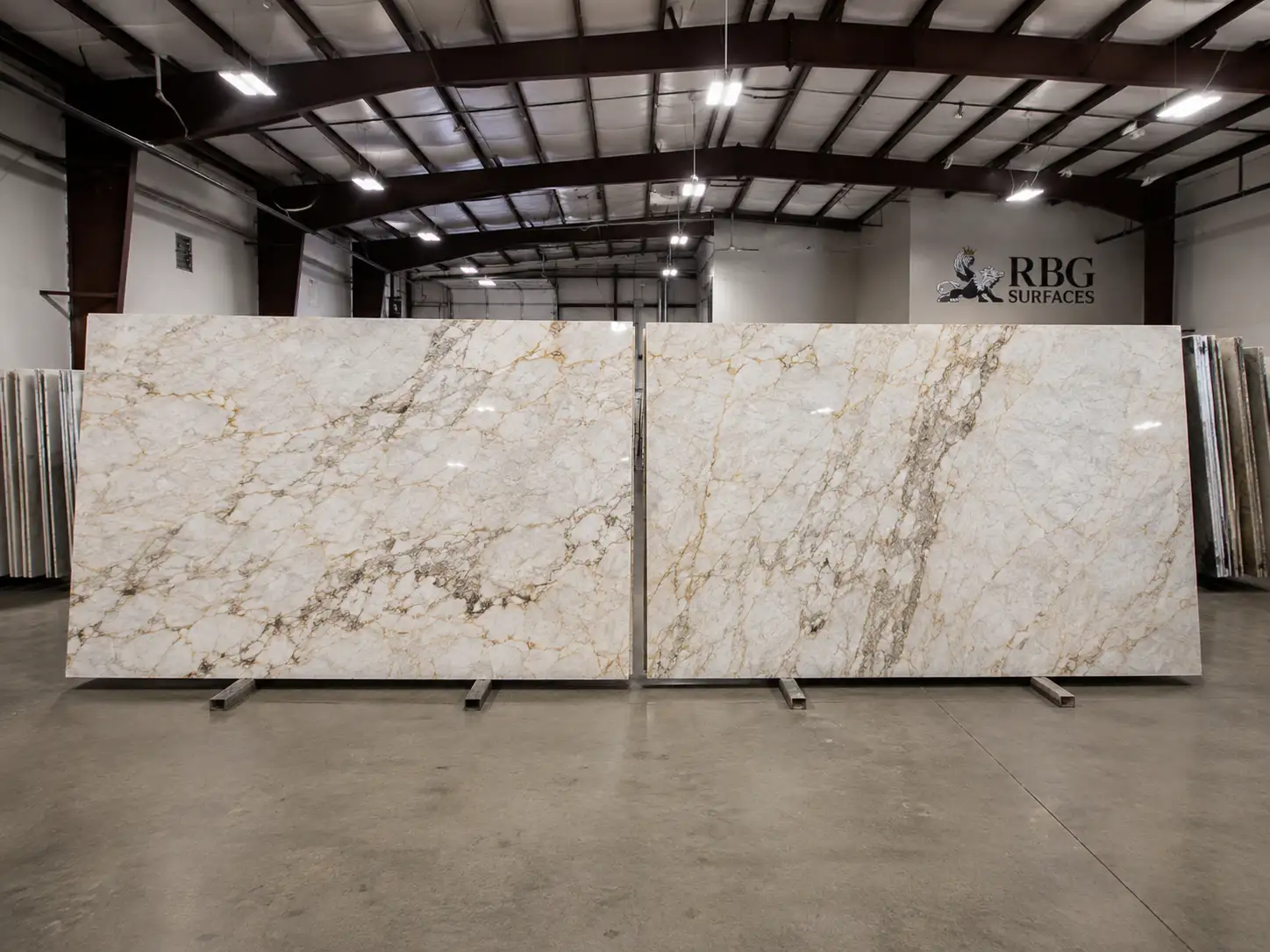
Natural stone is not manufactured to look identical from piece to piece. Two slabs with the same stone name can have noticeably different backgrounds, vein patterns, mineral deposits, movement, and coloring.
Stone inventories also change as slabs are purchased and new bundles arrive. Industry guidance commonly recommends selecting the actual natural-stone slabs intended for the project rather than assuming a similar replacement will be available later.
When your project requires more than one slab, ask whether the available pieces came from the same bundle or were cut from neighboring sections of the same block. They will not necessarily be identical, but related slabs often give the fabricator more flexibility when planning seams and transitions.
Engineered quartz is more consistent than natural stone, but that does not mean availability should be ignored. Colors can be discontinued, inventory can change, and slabs from different production batches may have slight visual differences.
The safest approach is to confirm the full quantity at the beginning rather than assuming an additional matching slab can be purchased later.
What Should Be Decided Before You Place a Deposit?
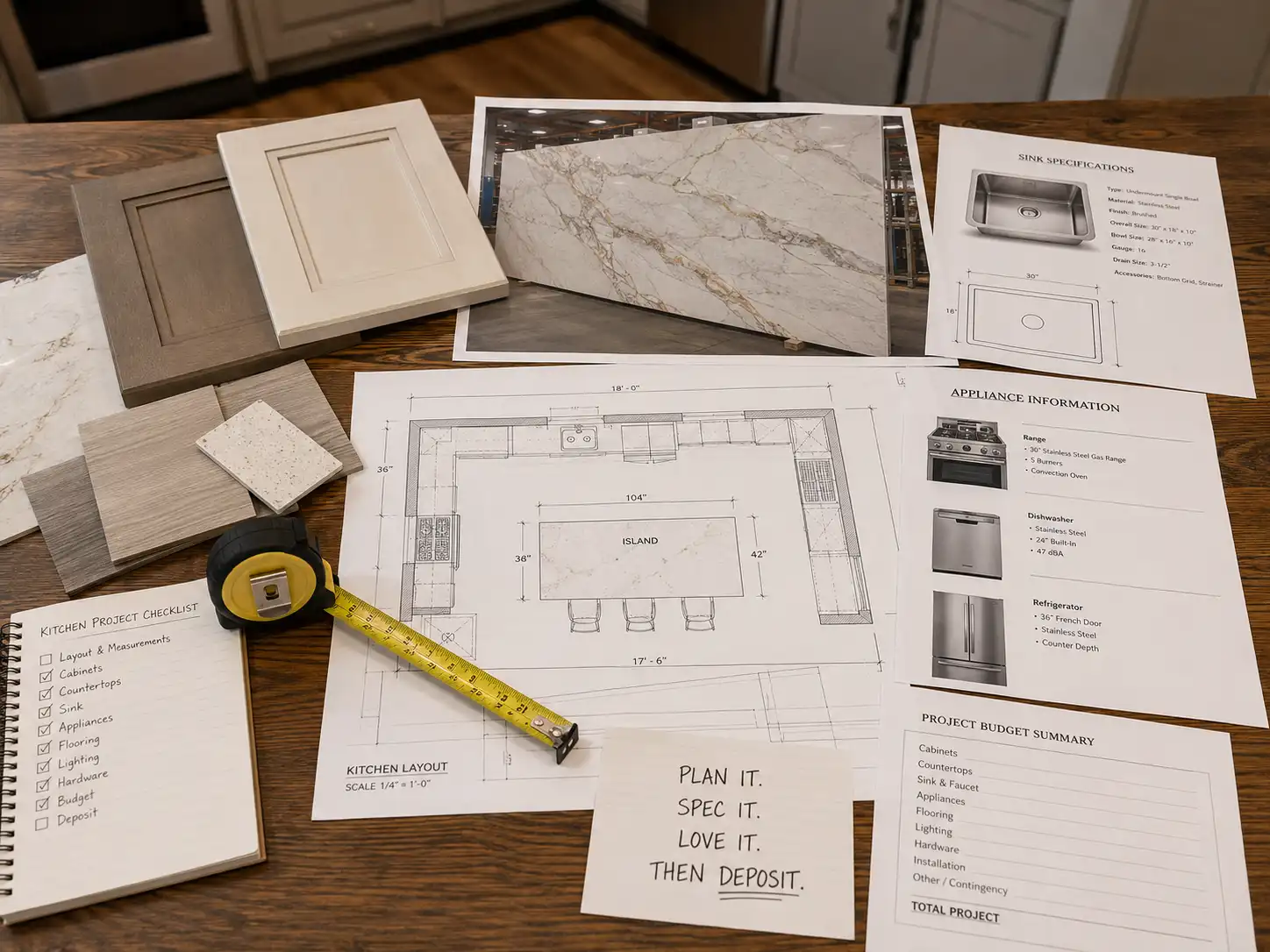
Your kitchen does not have to be completely finished before you reserve stone. It does need to be developed enough that the people involved can make a reasonable quantity recommendation.
Before placing a deposit, try to have the following decisions reasonably stable:
General Cabinet Layout
You should know the approximate location and dimensions of the perimeter cabinets, island, vanity, or other surfaces receiving stone. Small measurement adjustments are normal, but major layout sections should not still be appearing and disappearing from the plan.
Island Size and Shape
A larger island can change the entire slab calculation. It can also affect seam placement, slab orientation, and whether a second slab is required.
Countertop Applications
Confirm whether the stone will be used only on horizontal countertops or also on a full-height backsplash, waterfall panels, fireplace surround, shower surface, pantry counter, or other area. These additions can consume significantly more slab material than the main countertop alone.
Material and Thickness
Changing from one material or thickness to another can affect availability, price, weight, edge options, and fabrication requirements. You do not need every finishing detail chosen, but the primary material decision should be settled before it is secured.
Likely Slab Quantity
This should be reviewed with a fabricator rather than estimated only from the room’s approximate square footage. The goal is not to create a final cut plan months early but to avoid reserving too little material.
General Budget
Make sure the working budget accounts for more than the slab itself. Fabrication, installation, sink cutouts, edge upgrades, backsplashes, waterfall panels, removal, and other project details may affect the installed total.
What Can Usually Wait Until Closer to Templating?
Reserving the slab does not mean every countertop detail must be finalized immediately. Some decisions are normally completed later, once cabinets are installed and the fabricator can measure the actual space.
Depending on the fabricator and project, later decisions may include:
- Precise seam locations
- Exact sink and cooktop cutout dimensions
- Faucet and accessory-hole placement
- Minor overhang adjustments
- Final edge-profile confirmation
- Detailed vein placement within each countertop section
- Final field measurements
Your fabricator should tell you when each decision becomes permanent. Do not assume a detail can wait simply because it seems small, especially when it affects a cutout or the physical dimensions of the countertop.
Slab Selection and Countertop Templating Happen at Different Stages
You can select and reserve stone before the kitchen is ready to measure. In fact, choosing earlier can help you coordinate cabinet colors, flooring, paint, backsplash, and other finishes around the actual slab instead of a small sample.
Templating happens later. The fabricator needs the installed cabinets and other project conditions to be stable enough to take precise measurements before the slab is cut. Industry guidance generally separates early material selection from final templating, with templating occurring after the cabinets are installed.
This explains why two pieces of advice that sound contradictory may both be correct:
“Choose your slab now.”
“We cannot measure for your countertops yet.”
The slab can be selected and secured early. The final countertop dimensions cannot be created until the room is ready.
Reserving a Slab Does Not Put You on the Installation Schedule
This distinction matters when your remodel is already moving.
A slab reservation protects the material according to the supplier’s terms. It does not automatically schedule templating, fabrication, plumbing, tear-out, delivery, or installation.
RBG Surfaces is a stone supplier. We help you select and secure the slabs, provide full installed estimates through our fabricator network, and connect you with trusted local Treasure Valley fabricators, but we do not cut, template, fabricate, or install countertops in-house.
The fabricator controls the next operational steps, including:
- Reviewing the preliminary project
- Confirming the likely slab quantity
- Discussing fabrication and installation costs
- Identifying what must be completed before templating
- Scheduling the template appointment
- Creating the final measurements and layout
- Cutting and finishing the material
- Scheduling installation
Contacting the fabricator early is useful even when the template appointment is still months away. You can confirm the process, discuss the expected timeline, and make sure your project does not reach the cabinet-installation stage without a fabrication plan.
What If Your Project Changes After You Reserve the Slab?
Project changes are normal. Cabinet dimensions shift, islands become larger, sinks are replaced, appliance packages change, and homeowners sometimes decide to add a backsplash after seeing the full slab.
The important question is not whether anything might change. It is whether the likely changes could affect the amount of stone required.
A different faucet may not change the slab quantity. Adding a waterfall panel, enlarging the island, switching from a range to a cooktop, or extending the countertop into another area might.
When a major change occurs, send the updated plan to the fabricator before assuming the reserved material will still be enough. It is much easier to review the quantity while related slabs are still available than to discover a shortage during final layout.
What If the Installation Date Gets Pushed Back?
Construction schedules move for many reasons. Cabinets arrive late, inspections are rescheduled, flooring takes longer than expected, or another trade falls behind.
Before placing a deposit, ask what happens if your project is delayed. Useful questions include:
- How long can the exact slabs remain reserved?
- Are there storage limits after the deposit is placed?
- Does the deposit apply to these exact slab numbers?
- What happens if the project requires another slab?
- What happens if the project scope becomes smaller?
- Are there cancellation or transfer terms?
- Who should be notified when the construction schedule changes?
Do not rely on assumptions or another supplier’s policy. Hold periods, deposit terms, storage rules, and cancellation policies can vary, so confirm the terms that apply to your specific material and project.
Is It Riskier to Reserve Too Early or Wait Too Long?
Either choice can create problems when it is made without enough information.
Reserving too early can be risky when the cabinet layout is still being redesigned, the island size is unknown, or no one has reviewed the slab quantity. You may secure material that does not cover the final project or commit to multiple slabs before the scope is clear.
Waiting too long can be risky when you have found a distinctive natural-stone slab, need several related slabs, or have a firm construction deadline. The exact piece may sell, matching slabs may become unavailable, and your fabricator’s schedule may fill while you restart the selection process.
The best timing is not based on a universal number of weeks or months. It is based on project readiness.
You Are Probably Ready to Reserve the Slab When:
Your general cabinet and island layout is stable enough for a preliminary review. The major stone applications have also been identified, including backsplashes or waterfall panels.
A fabricator has reviewed the plan and estimated the likely slab quantity. You understand the supplier’s hold, deposit, storage, and cancellation terms, and you are comfortable securing the exact material under those terms.
You should also have a realistic project budget and a general construction timeline. The final template date does not need to be scheduled yet, but you should know who will fabricate the stone and what must happen before measurements can be taken.
You May Need to Pause Before Placing a Deposit When:
The cabinet plan is still changing significantly, the island dimensions are undecided, or additional stone applications are still being discussed. You should also pause when no one has confirmed whether the project needs one slab or several.
A deposit may also be premature when you do not understand what it secures, how long the material can be stored, or what happens if the schedule changes. Use the temporary hold period to get those answers rather than making the decision under unnecessary pressure.
A Practical Countertop Reservation Timeline
A well-organized project usually moves through the following sequence:
1. Select the Exact Slab
Choose the actual slab or slabs you want used for the project. For natural stone, record the slab numbers and photograph each piece so everyone involved is referring to the same material.
2. Use the Complimentary Seven-Business-Day Hold
Ask RBG to place the material on a temporary hold and confirm the exact expiration date. Use this period to review the project rather than assuming the approximate square footage is enough.
3. Have a Fabricator Review the Preliminary Plan
Provide the available cabinet drawings, island dimensions, sink information, and details about backsplashes or waterfall panels. Ask the fabricator to estimate how many slabs the project is likely to require.
4. Confirm the Complete Quantity
Make sure every slab required for the current scope is included. When several natural-stone slabs are needed, review how well they coordinate before purchasing them.
5. Purchase the Slabs
Once the likely quantity and project scope have been reviewed, complete the purchase. RBG can then hold the purchased material for up to one year while the rest of the project progresses.
6. Keep RBG and the Fabricator Updated
Construction schedules can change. Keep the team informed about major delays, revised cabinet plans, larger islands, added backsplashes, or other changes that could affect the quantity or project schedule.
7. Prepare the Space for Templating
Complete the cabinets and finalize the sink, appliances, faucets, supports, overhangs, and other details required by the fabricator. The fabricator should provide a readiness checklist before measuring.
8. Schedule Templating, Fabrication, and Installation
Once the space is ready, the fabricator will take precise measurements, create the final layout, cut the purchased material, and schedule installation.
Questions to Ask Before Reserving a Countertop Slab
Bring these questions to the supplier and fabricator so you can make the decision with fewer unknowns:
- How long is the complimentary hold?
- What happens when the complimentary hold expires?
- What exactly does the deposit reserve?
- Are these the exact slabs that will be used for my project?
- Has the likely quantity been reviewed by a fabricator?
- Are all required slabs from the same bundle or production batch?
- How long can the material be stored?
- What happens if my construction schedule changes?
- Which project details must be final before templating?
- Does reserving the slab affect the fabrication schedule?
- Who should I contact when my cabinets are ready?
- What could cause the quantity estimate to change?
You do not need to become the expert on every step. You do need clear answers from the people responsible for supplying and fabricating the stone.
Frequently Asked Questions
Can RBG hold my slab if installation is several months away?
Yes. Once you purchase the slab, RBG Surfaces can hold it for up to one year. This allows you to secure the exact stone while waiting for cabinets, construction work, or other project stages to be completed.
How long can RBG hold a slab before I purchase it?
RBG offers a complimentary hold for up to seven business days. Use that time to have a fabricator review the preliminary layout and confirm the likely slab quantity.
What is the difference between the seven-day hold and the one-year hold?
The seven-business-day hold is a complimentary temporary reservation before purchase. The one-year storage period applies after the slab has been purchased.
Should I purchase the slab if my cabinets are not installed yet?
You can purchase the slab before the cabinets are installed when the preliminary layout is stable and a fabricator has reviewed the likely quantity. Final templating will still happen later, after the cabinets and other required project components are ready.
Does the one-year storage period include fabrication and installation?
No. RBG stores the purchased slabs, but templating, fabrication, and installation are handled separately by the fabricator. RBG can connect you with a trusted Treasure Valley fabricator to help coordinate those next steps.
What if my project changes while RBG is holding the slab?
Tell the fabricator about significant changes as early as possible. Enlarging the island, adding waterfall panels, changing the cabinet layout, or adding a full-height backsplash could increase the amount of stone required.
Clear Next Steps for Boise-Area Homeowners

When you find the right slab before your project is ready, place it on RBG’s complimentary seven-business-day hold and send your preliminary plans to a fabricator. Confirm the likely slab quantity, review the complete project scope, and make sure all required matching slabs are included.
Once the material is purchased, RBG Surfaces can hold it for up to one year. You can protect the exact stone you chose without rushing your cabinets, templating, or installation before the space is ready.
Visit RBG Surfaces at 5103 N Sawyer Avenue in Garden City, Idaho, or call (208) 376-7328 to discuss your slab and project timeline. We are open Monday through Friday from 9:00 AM to 5:00 PM and Saturday from 10:00 AM to 3:00 PM. Walk-ins are welcome.